|
Product Details:
|
| Application: | Proton Therapy, LINAC And Synchrotron Bunkers | Antimony Content: | ≤ 5 Ppm |
|---|---|---|---|
| Bismuth Content: | ≤ 10 Ppm | Silver Content: | ≤ 10 Ppm |
| Purity: | ≥ 99.994 % Pb | Test Report: | Gamma Spectroscopy Per Heat |
| Highlight: | low activation lead sheet,accelerator shielding lead,proton therapy bunker lead |
||
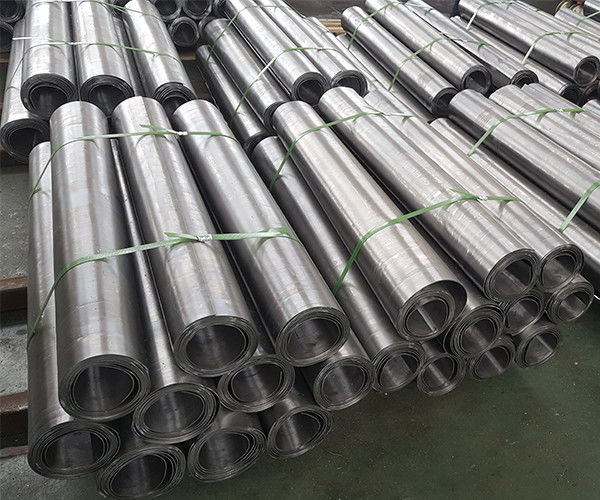
Accelerator lead shielding sheets are produced from low activation lead for proton therapy, linac and synchrotron bunkers, where the shielding itself becomes radioactive over years of service. Standard lead contains trace antimony, bismuth and silver, and those elements are the ones that produce long lived gamma emitters when they are exposed to a high energy neutron field. By holding antimony below five parts per million, bismuth below ten and silver below ten, the induced dose rate inside the bunker falls sharply, and maintenance work on the accelerator can be planned without long cool down periods or heavy dose budgeting.
The eight millimetre gauge is the common building block for bunker walls: it can be layered to reach any calculated thickness, it can be cut and fitted around penetrations, and it can be combined with borated polyethylene where neutron capture is needed as well as gamma attenuation. Each heat is sampled and analysed by gamma spectroscopy after irradiation, and the certificate of analysis travels with the bundle so that the health physics team can enter the material directly into the facility activation model. We supply full sheets, cut blanks and drilled plates for cable penetrations.
Key Features| Parameter | Specification |
|---|---|
| Application | Proton therapy, linac and synchrotron bunkers |
| Thickness | 8 mm standard, 4 - 30 mm available |
| Purity | ≥ 99.994 % Pb |
| Antimony | ≤ 5 ppm |
| Bismuth | ≤ 10 ppm |
| Silver | ≤ 10 ppm |
| Width | ≤ 1300 mm |
| Length | ≤ 6000 mm |
| Density | 11.34 g/cm³ |
| Test Report | Gamma spectroscopy per heat |
| Standard | GB/T 1470-2014 |
Low activation lead is specified for proton therapy gantries and beam lines, medical and research linacs, synchrotron hutches, neutron spallation target areas and hot cells that handle activated components. In these facilities the shielding wall is itself a radiological inventory, so material chemistry matters as much as density. Choosing a low antimony lead can remove a major contributor from the activation model and reduce the cost of eventual decommissioning.
The product is also used for shielding around isotope production targets and for local shielding that has to be moved by hand during maintenance, where residual activity on the shield itself determines how long a technician can stay in the room.
Packaging & Quality AssuranceSheets are interleaved with neutral paper, packed in timber cases stencilled with heat number, dimensions and net weight, and shipped with a certificate of analysis and gamma spectroscopy report inside the case. Cases are sized to suit a pallet truck so that they can be moved through a bunker access maze.
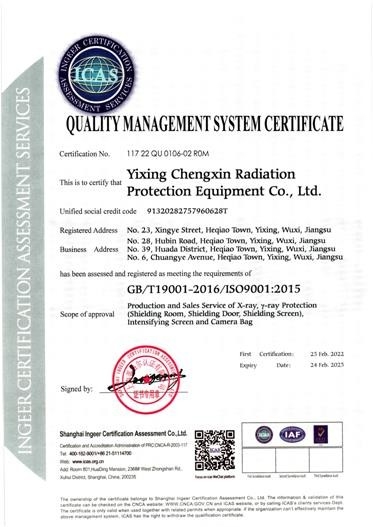
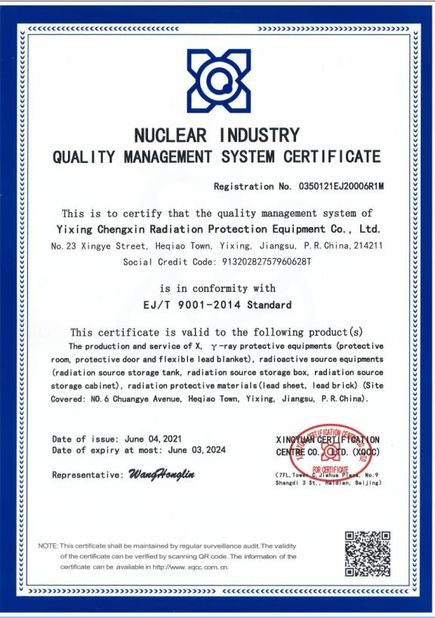
The plant operates to GB/T 19001-2016 and has held CE certification for radiation protection products since 2016. Chemical analysis is performed by optical emission spectroscopy on every heat and confirmed by independent laboratory on request. Where a project requires it, we can hold material in quarantine until the customer's health physics group has reviewed the certificate before dispatch.
Contact Person: Mr. Joseph
Tel: 15961556190
Fax: 86-510-8781-6996